

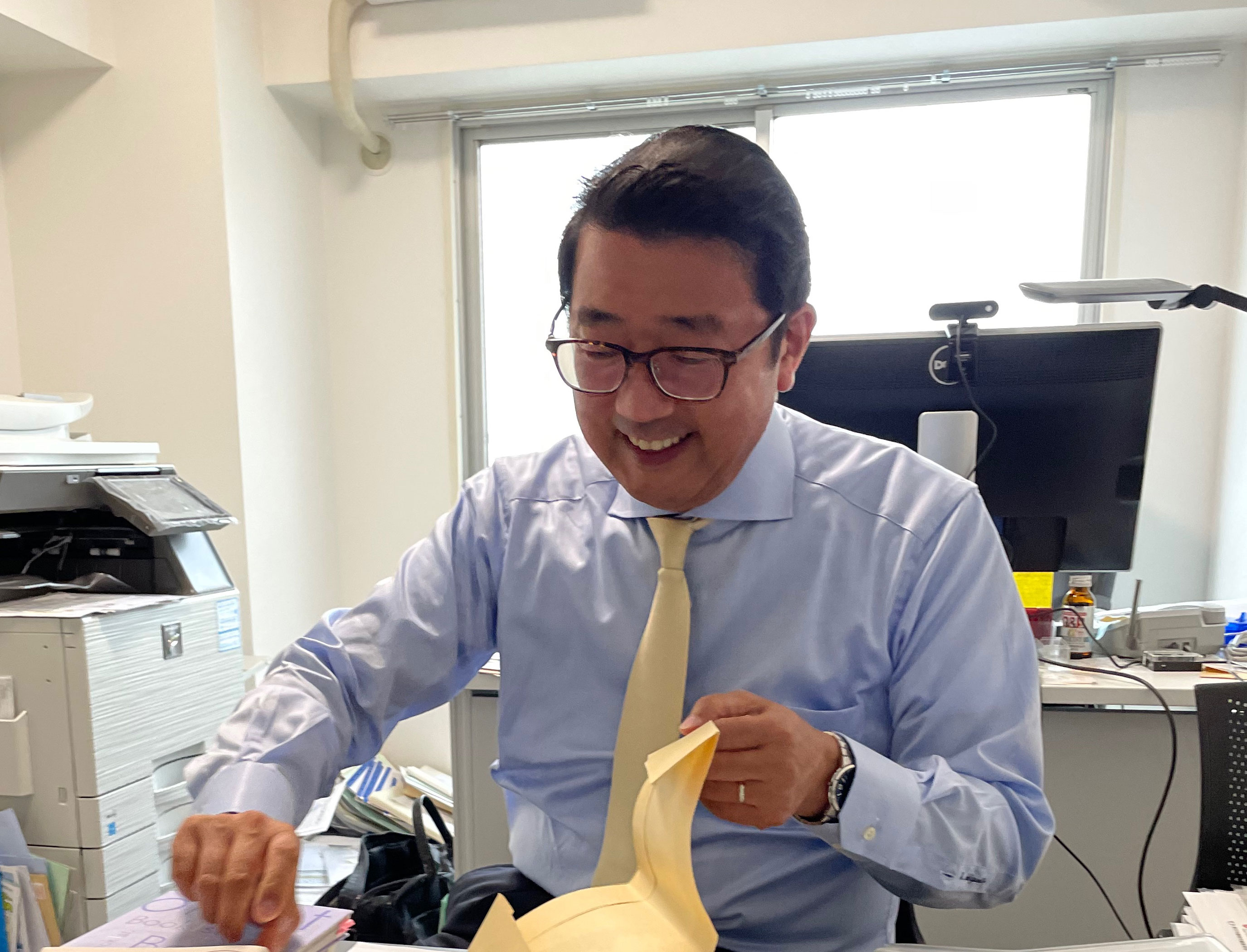
Photo: Staff O
"PLUG IN │ Editorial" is a trade show co-hosted by two companies rooted in media and retail — Senken Shimbun on the media side, and CREDITS on the retail side. The show is built around creating an environment where real business conversations can happen. At the same time, it offers a range of support programs tied to exhibiting, and among them, introductions to specialists are in especially high demand from exhibitors.
This time we interviewed one of the specialists PLUG IN partners with — a professional in labor affairs, labor and social security attorney ("shakai hoken roumushi") Katsumi Sekiguchi. What kind of person is Mr. Sekiguchi? What does a labor and social security attorney actually do? We talked with him, taking the occasional detour along the way.
text by Office Staff O
"What got me into a licensed profession? I think I've told you this before, but after graduating university I was studying for the bar exam. And I studied for a stupidly long time. From graduating until around 30, I think.
And it just wasn't working out — I started wondering what was going to happen to my life."
I knew Mr. Sekiguchi held several qualifications beyond labor and social security attorney, so at the start of the interview I asked how he'd ended up in a licensed profession. We were on the 10th floor of a building in Sasazuka, Tokyo, where his office is. Through the window, the high-rises of Nakano were visible.
"Back then, at the exam-prep school where I worked part-time as an instructor, there were plenty of people around who'd later go on to become prosecutors-general in the legal world. I still remember this — I was smoking with a guy about ten years younger than me who also worked part-time as an instructor at the same school, and he said to me, 'Mr. Sekiguchi, aren't you going to take the labor and social security attorney exam?'"
Search "Shibuya-ku labor and social security attorney" and Mr. Sekiguchi's name comes up near the top of the results — a track record built up over many years of trust. But at that point, he says, he didn't even know the profession existed.
"I had no idea at all. But I thought, well, might as well give it a shot (laughs). Very casual — 'okay, I'll pick up an application form.' Then when I actually started studying for it, it turned out to be genuinely boring (laughs). The most boring exam I'd studied for out of all the qualifications I'd pursued."
His first attempt failed since he barely had time to study, but he passed on his second try. Combined with the administrative scrivener ("gyousei shoshi") qualification he'd earned the year before, he started thinking about going independent. Right around that time, an offer came in to take over an office that was closing down.
"Nothing but reckless — someone with no experience hanging out a shingle (laughs). That teacher had already given office space to a tax accountant and a labor and social security attorney, and I think I came in as the third. There was no administrative scrivener there at the time, so I took over the entire administrative-scrivener side of the practice."
He went independent in 2009. He opened his practice in an office along Meiji-dori in Shibuya, shared with a few other licensed professionals. From the start, he had several client companies already retained. Over time, he went on to accumulate a long list of qualifications.
"Because I have a legal background. Real estate transaction agent ("takken") too. Condominium manager too, I think. The similar qualification, building management representative, wasn't purely legal — it also required construction knowledge, so that one was tough. I went to a prep school to study the construction side. Right now I've cleared four of the CFP exam's subjects, and I'm aiming to pass all of them next year (this interview took place in October 2022). Before that, I'm also planning to take the Class 1 Health and Safety Manager exam."
The blue shirt he was wearing that day, apparently brand new, had "K.SEKIGUCHI" embroidered on it. Mr. Sekiguchi is a sharp dresser.
"Some people call me a qualification junkie. Well, I can't really argue with that — but I think studying for these exams broadens what I can do professionally and opens up more possibilities. The CFP knowledge ties into long-term care insurance and post-retirement life too. There's basically no one it's entirely unrelated to. For example, if I could run a seminar on life after retirement, that would give it real shape."
Laughing that there's really no special study method, he opened up the textbook for the Class 2 Health and Safety Manager exam he'd just passed, to show me — it was packed edge to edge with pencil notes.
I asked what he finds appealing about being a labor and social security attorney.
"I think that maybe ten years ago, the core of the job was mainly procedures — social insurance, labor insurance paperwork. But now e-filing has become standard, and there's a growing awareness that it's not actually that difficult to handle in-house. So I think the amount of pure procedural work is only going to keep shrinking. Not to put it too bluntly, but even someone who joined a company straight out of high school can learn to handle it once they get used to it — being a licensed professional doesn't really factor into that much. Right now the focus is shifting toward 'people-related issues,' and I think that's where the future of this profession lies too. So I don't think we can survive, or be chosen, unless we dig deeper into that side of things."
Having laid out the current state and future of the profession in one breath, Mr. Sekiguchi shared the keyword that guides his own work.
"'Finding an answer where there is no right answer' is the keyword I use for my work. Drawing on experience, on knowledge gained through study, absorbing input from all kinds of places, thinking it through in my head, and squeezing out an answer. I think that's the path this profession survives on, and it's also what makes the work interesting — I never get bored of it."
In labor issues, there are moments where the company's perspective and the worker's perspective come into conflict.
"What we can offer is prevention — how to keep things from turning into a dispute in the first place. There aren't many lawyers who work on preventing labor problems. Lawyers are fundamentally troubleshooters, brought in after a dispute has already arisen."
Mr. Sekiguchi told me about a case that ended up going to a labor tribunal. In the end, they had to bring in a lawyer and pay a large settlement. If more effort had gone into prevention before it reached that point, things might have gone differently.
"Do different industries have their own characteristics? Of course they do."
That industry is like this, another industry is like that — he told me plenty of behind-the-scenes stories that can't be printed here.
"A lot of this is off the record — is the interview going to be okay? (laughs)"
The conversation wandered off track, and at some point had drifted onto the topic of dementia.
"I think it comes down to curiosity and mobility. If you have curiosity, you want to see things, hear things, try things. People like that stay lively and live long. Seeking out connections with people, and going out to find them. Yeah — curiosity and mobility matter, I think. I find myself thinking that more and more these days."
His hobbies are eating and stream fishing. He often goes to Yozawa in Akiruno, Tokyo. He takes the river fish he catches home and smokes them. When he's fishing, his mind goes completely blank — sometimes for around ten hours. He says that time is absolutely essential for keeping himself in balance.
"What I'm aiming for is to build a 'workplace that's easy to work at' together with my client companies. A 'workplace that's easy to work at' can mean a lot of different things. I try to propose what's actually needed to put those different meanings into practice."
He once proposed a mechanism called "thank-you cards" to a client company — a system where employees rate each other's good points. It's a way of rewarding the kind of mutual support at the front line that's hard for management to see, with a small cash token. Both the employer and the employees were pleased with it.
"What I'm aiming for is this: every company has its own mix of different factors, and within that, I think it through, come up with an answer, and make a proposal. I think that's where the future of this profession lies."
A broad foundation of legal knowledge underpins it all, with the two qualifications — labor and social security attorney and administrative scrivener — as the trunk. And from there, multiple other qualifications branch out.
"Look what I made." After the interview wrapped up, he showed me a flowchart he'd put together himself, laying out the key labor-management points from an employee's mental-health leave through to their return to work — something he'd made on his own initiative, to make things easier for his client companies to understand.
There's something about Mr. Sekiguchi that doesn't quite fit the stereotype of a "sensei," a certain lightness to him — and yet he's deeply sincere. And genuinely caring.
I thought he was a professional who'd be a great fit for the fashion industry.
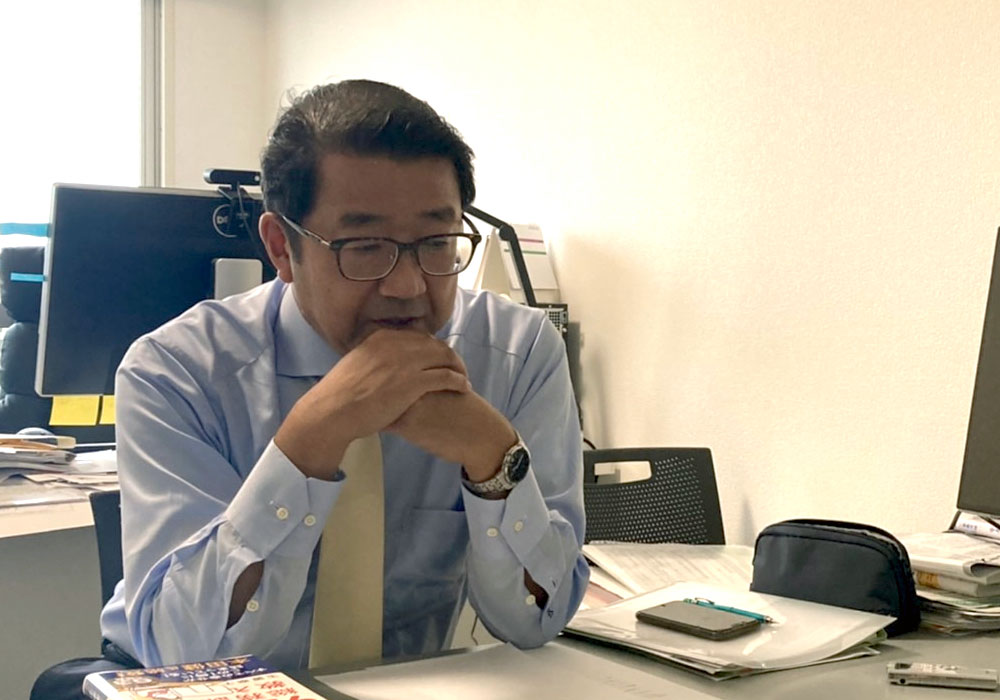
Photo: Staff Y
For details on our partner program, see here