

Photo: Daisuke Kobayashi
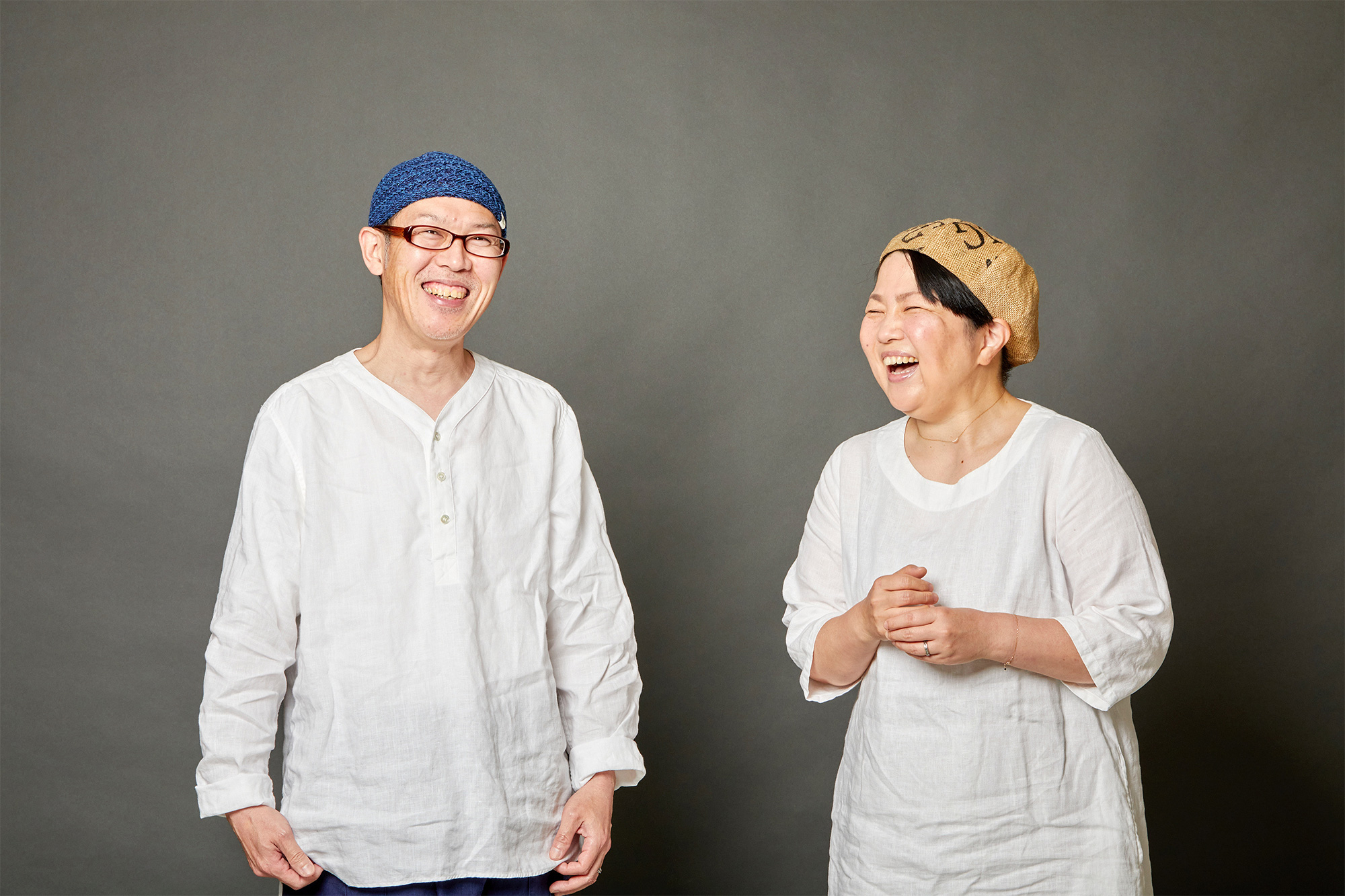
"HOLOHOLO BIYORI," a bag brand made from the burlap sacks once used to hold imported coffee beans, has won a following for its distinctive prints and rustic texture. Since April, it has become a two-person operation run by a married couple. Balancing being a "creator" with being a "sole proprietor," Yuki Homma is now exploring what comes after the pop-up shop.
text by Office Staff O
Plenty of people in the world call themselves "creators." Alongside the recent boom in C2C markets, more people than ever earn a little money from what began as a hobby. But how many actually make it their livelihood — their real job? "HOLOHOLO BIYORI," the bag brand from Atelier Omoi (written 想木, read "omoi"), exhibited at PLUG IN in October 2020. The brand makes bags and small goods from burlap sacks that once held coffee beans imported from overseas. That show led, one after another, to pop-up opportunities at department stores. While pursuing her craft as a creator, Yuki Homma has also put the business on a solid footing. We visited her atelier, which she moved into just last December, to hear about "where she's been" and "where she's headed" (the interview took place in July 2022).
"I was born in a really rural part of Miyagi — genuinely red-cheeked, country-girl stuff, a childhood with nothing to do with fashion at all (laughs). I woke up to fashion in junior high. A classmate wore her own clothes to cram school, and they were so stylish it made my heart race. I remember thinking, how do you even find fashion like that?"
Asked what sparked her interest in fashion, that's how Yuki Homma began. She'd always dreamed of entering the fashion world, but ended up going to a university in an unrelated field.
Family circumstances forced her to drop out. She then moved to Tokyo, and her first real contact with the fashion industry came from a part-time sales job at a jeans-casual shop. The person in charge of the commercial facility where the shop was located complimented Homma's window displays.
"He told me sales went up whenever I did the storefront display. That made me so happy — I realized how interesting display work could be. That's what led me to the Display Department at Bunka."
Using a scholarship program, she re-enrolled, this time in the Display Department at Bunka Fashion College, dyed her hair pink, and studied while immersing herself fully in the world of fashion.
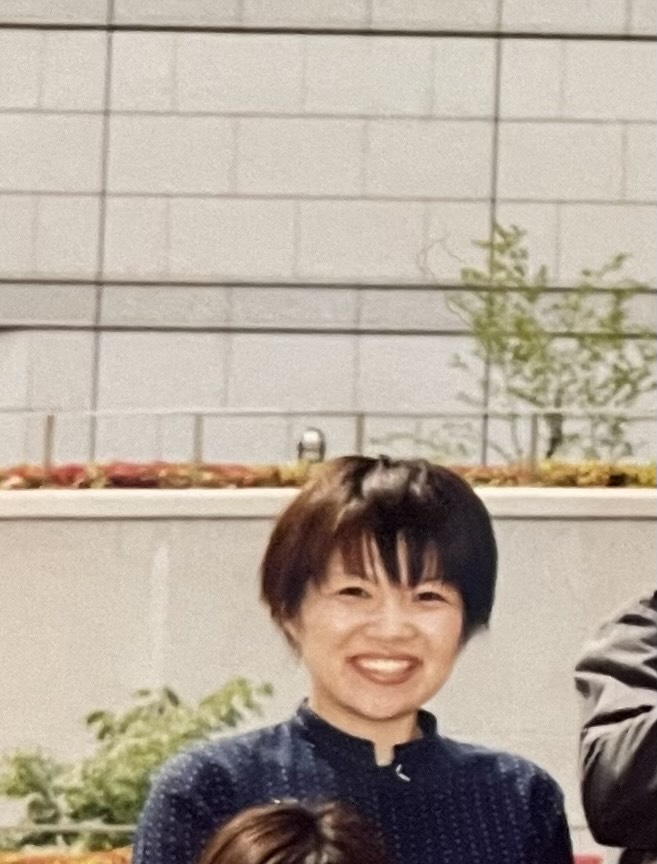
When she first enrolled at Bunka Fashion College. Photo courtesy of Yuki Homma
"Back then, there were still companies that specialized purely in display work. But what I studied at Bunka was almost entirely centered on department stores, so my interest gradually faded (laughs). In my 20s I had no interest in department-store brands. Still, I wanted to stay in the fashion industry somehow, so I looked through job listings and found sales work for apparel-related materials."
By then it was already the Heisei era, but the company still had a thoroughly old-school, Showa-era culture — entertaining clients night after night, brutal workloads, and having to communicate with factories in China even on weekends.
"I was maybe around 30. It was just relentless. I'd get home, eat a convenience-store bento, take one bite, and pass out face-down on the table (laughs). Waking up in the morning without having actually chewed my food."
Eventually her health gave out, and she moved to a company doing office work. That's where she met the man she would marry, Isamu Homma. After marrying, she spent some time as a full-time homemaker.
"'Full-time homemaker' is generous — it was basically doing nothing. Outside of housework, I moved maybe two millimeters, morning and evening. But after about six months I got bored. That's when I started making clothes for the dog we had."
She'd been dressing their Chihuahua in off-the-shelf dog clothes, but was frustrated that the colors and patterns never matched her taste, and that the rear always rode up. So she pulled out the sewing machine she'd gotten for a school assignment back in her college days and started making dog clothes herself.
"Blogs were huge back then, and there were a lot of housewife bloggers. Beyond writing about everyday life, it was trendy to sell handmade items through your blog. So I thought I'd give it a try, and the moment I put things up for sale, orders started coming in — a hundred pieces at once, right from the start. I hadn't thought about it as a business at all back then, so if everyone else around me was charging ¥1,000, I'd just charge ¥1,000 too. And once it sold out, that was it. But as I kept going, the frustration slowly built up. Once I opened the cart and orders came in, I'd be tied up making pieces for two or three months, and there was this unspoken rule that you had to accommodate custom sizing. There were base sizes, but it was a world where people expected you to make something to the millimeter for their own dog. And it became clear to me — this isn't actually what I want to be doing."
At first, she was simply thrilled that things she'd made were selling. But eventually, taking orders became a source of pain. And yet, there was still a part of her that genuinely loved making things.
"There are so many dog breeds, so many coat colors, and depending on what you dress a dog in, the owner's view of the dog's back can become its own little world of art, I thought. The dog's back is like the artwork — the canvas — so if the clothes ride up and ruin that art, it's all wasted. So I made sure to sew it properly, so it wouldn't ride up."
That experience became the origin of what would eventually turn into the coffee-sack bags. It was also when the brand name "HOLOHOLO BIYORI" was born.
What she wanted to do, and what she didn't, gradually became clear. "I want to start over." Just as she was thinking that, her husband Isamu's overseas posting — a move to the US — came up.
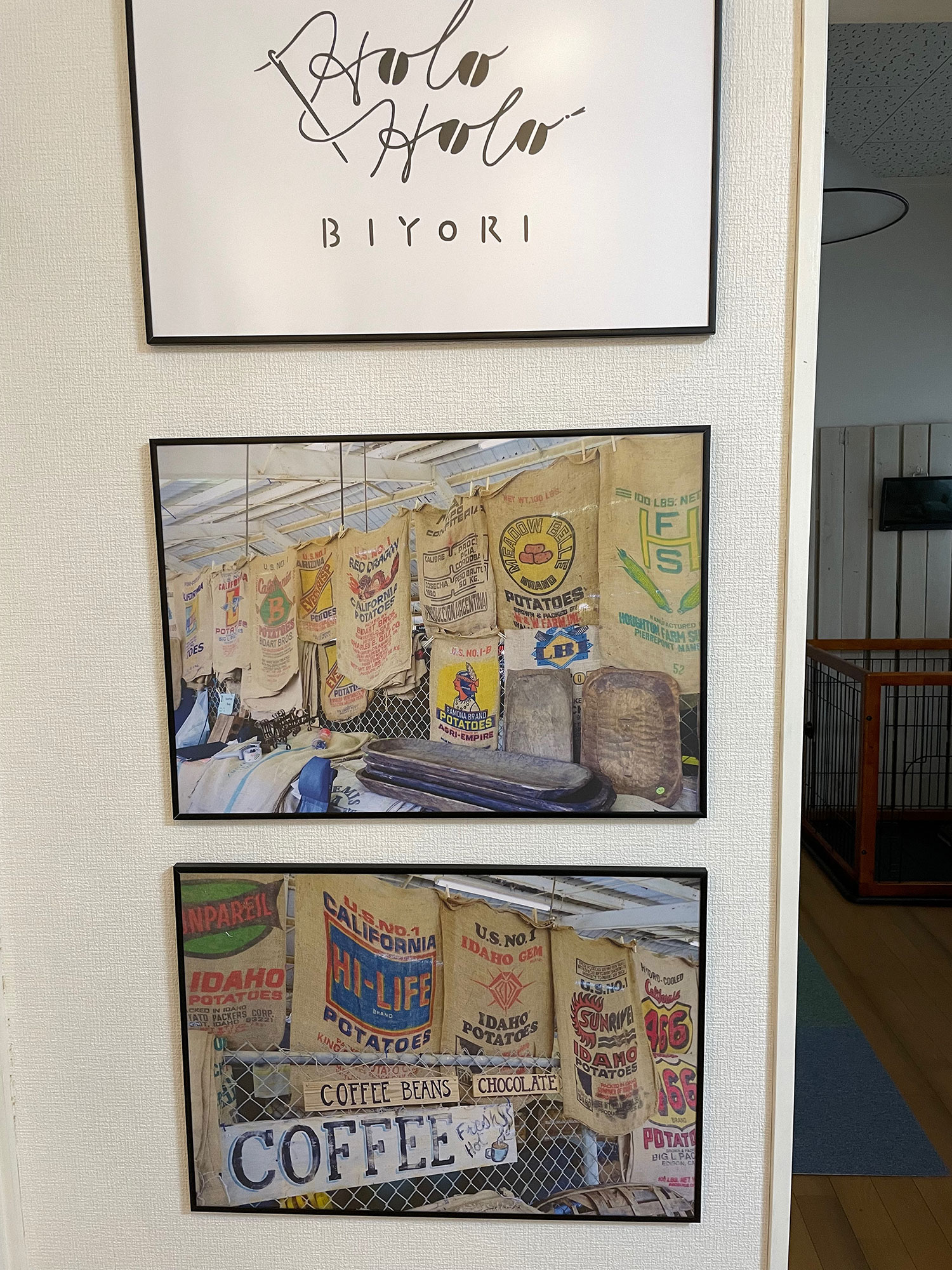
"Holoholo" is a Hawaiian word meaning to go for a stroll. Photo: Staff O
"I actually said something awful to Isamu. 'You're stealing my time' (laughs). Just as I'd clearly figured out what I wanted to do, and wanted to properly turn it into a business, the move to America came up. Just when I was trying to rebuild."
Even so, she decided to go with him, and told herself, somewhat naively, that she could surely do some kind of groundwork toward relaunching HOLOHOLO BIYORI while in America. His posting was in Tennessee, in the southern US. Isamu worked as a salaryman for a listed company.
"Basically the classic expat wife, full-time-homemaker, second-time-around thing (laughs). At first I couldn't speak any English, and I wasn't confident driving either. Right after we arrived I was learning English from a Japanese teacher, but I ended up relying on that too much and it wasn't working. So I decided I wanted to properly learn from a native speaker. I found a good teacher downtown, and started driving myself to get to her lessons. And that's when I basically turned into a delinquent housewife (laughs) — driving myself everywhere."
Her native-speaking English teacher introduced her to popular local spots and cafés, and she'd drive herself out to explore. On weekends she started going to craft markets and flea markets.
"There's a famous market in Nashville called Tennessee Craft, where people doing craft businesses gather — sewing, bags, leather, woodworking, horseshoes, western boots. It's on a completely different scale from Japan's outdoor flea markets. It wasn't the ¥1,000-or-¥2,000 kind of selling I'd experienced in Japan — everyone there was running it as a real business. I was hugely inspired, and this experience might be the very first time I thought, 'I want to make a living through making things.'"
People running businesses at craft markets, and closer to home, even her English teacher was making a living from lessons — she was exposed to the way of life of a sole proprietor. It was also at one of these flea markets, where people like that gathered, that she first encountered the coffee burlap sacks.
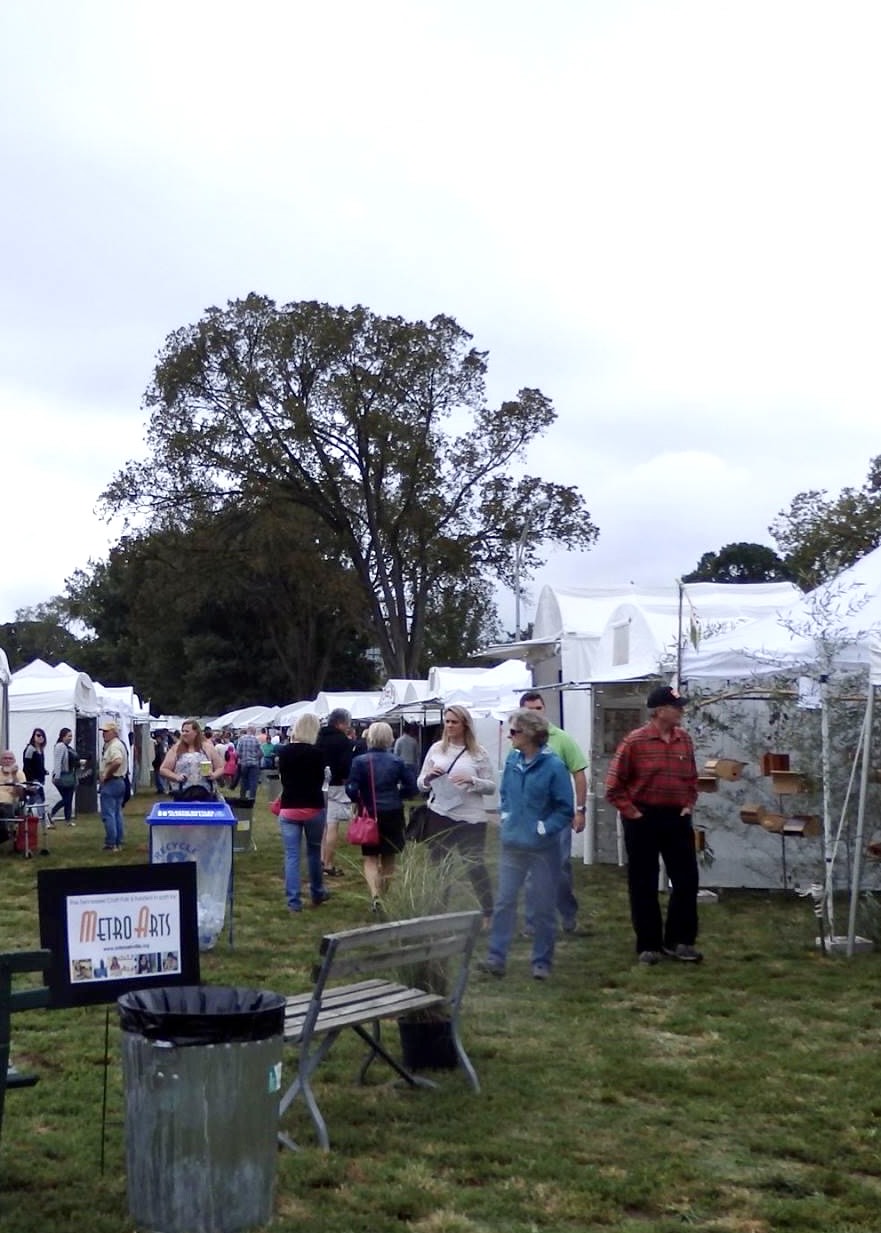
The American craft markets she visited often. Photo courtesy of Yuki Homma
"It was a booth that used to be a cattle barn, and it had this overwhelming number of burlap sacks covering the whole space — I just froze, completely stunned. I was so moved I couldn't move. I fell completely for the material."
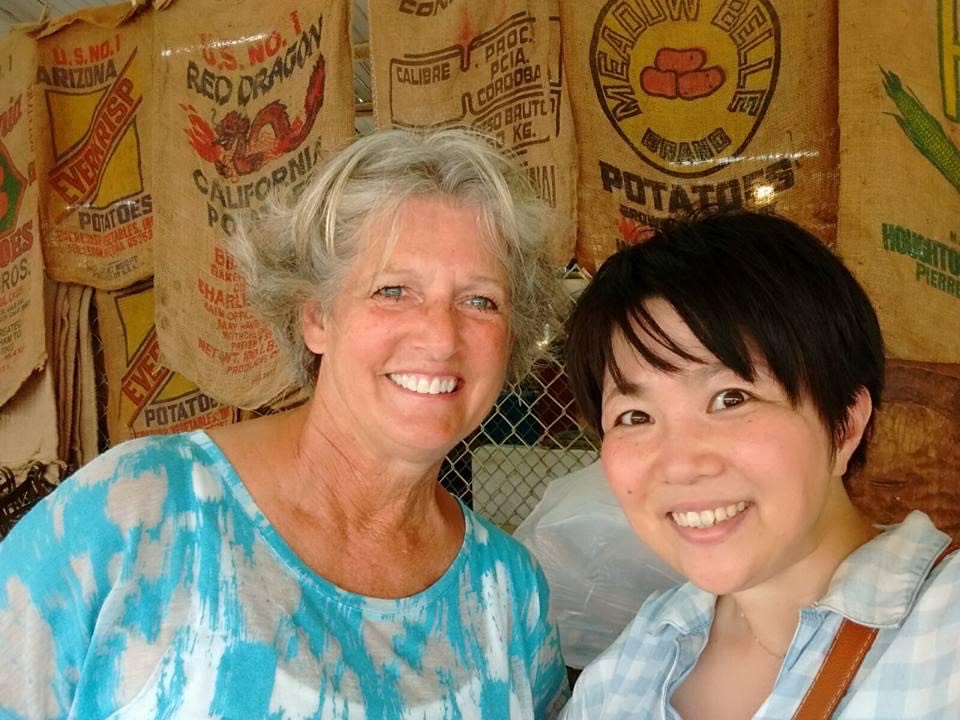
Pam, the burlap-sack vendor, with Yuki. Photo courtesy of Yuki Homma
From that day on, she kept visiting flea markets, gradually collecting burlap sacks little by little, and as the image of making bags from this material started to take shape, the timing for their return to Japan after three years abroad was approaching.
Meanwhile, Isamu's work there had become extremely demanding, coinciding with a period of restructuring the local business. It was nothing like the expat life she'd imagined.
"Normally he could just get up around 6am and go to the office, but suddenly he'd say he needed to get up at 3am and go in, even when there was no real need to. Other times it would be 1am. I think he was pretty worn down mentally. So I felt I had to help keep his spirits up, and — with zero basis for it — I told him (he was 45 at the time) that I'd get him to quit the company by the time he turned 50."
Yuki returned to Japan ahead of Isamu, and began making bags from the burlap sacks she'd collected in the US, along with sacks she negotiated directly from Japanese coffee roasters to obtain.
"The more I researched the characteristics of burlap as a material, the more I found nothing but drawbacks (laughs). Durability, fraying — all of it. There was nothing to do but keep refining the process and quality as I went."
Turning burlap sacks into raw material requires washing, drying, and ironing — steps that simply can't be skipped. She built up quality bit by bit, layering in small improvements at every step.
"If even one person in a thousand said something negative, my competitive streak would kick in — I'd think, I'll make sure no one ever says that again, and stubbornly keep refining things."
This was a material with no textbook to follow — trial and error, over and over. It's more sensitive to humidity than ordinary fabric, so you need to pick at least three consecutive sunny days to dry it. To reproduce the surface pattern without distortion, she irons it from the back, going purely by feel. The process the two of them call "totonoe" ("setting right") is a genuine craft.
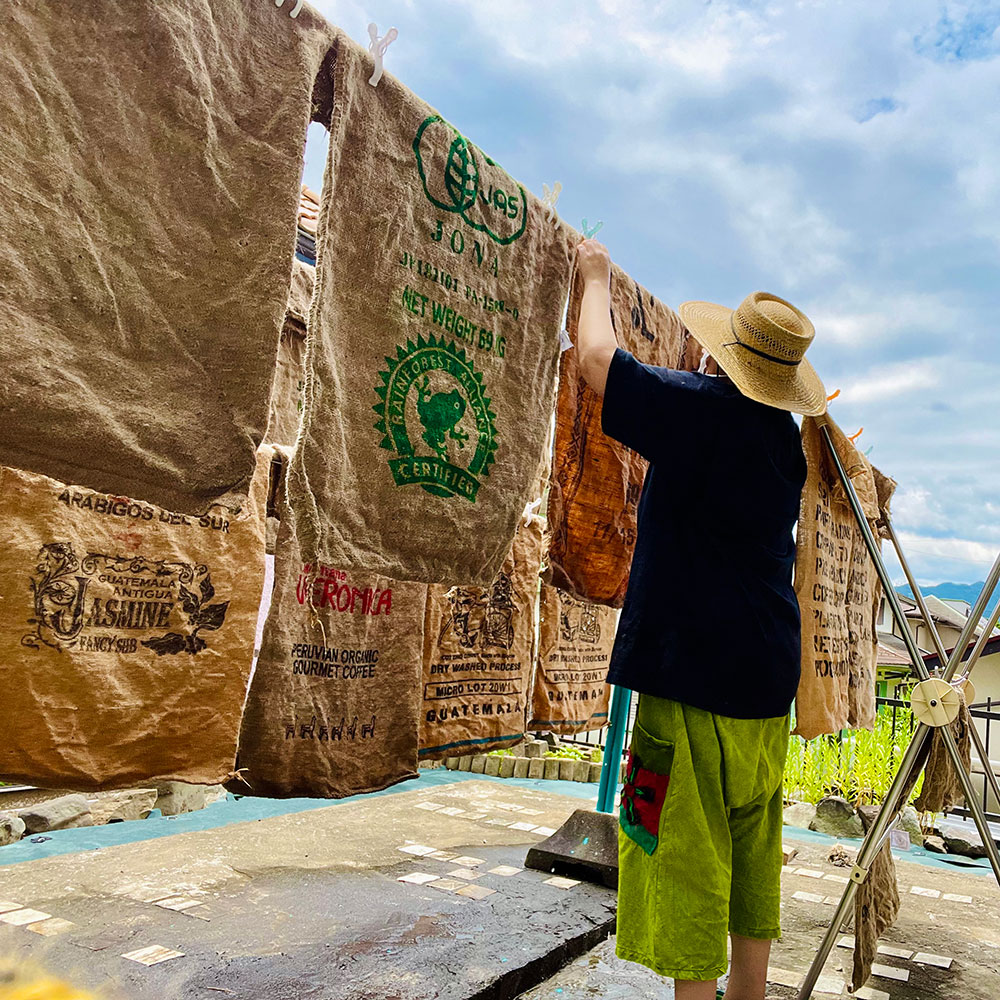
Drying the burlap requires at least three consecutive sunny days. Photo courtesy of Yuki Homma
When she first started making bags, her sales channel was the C2C market. At the very first market event where she sealed away the dog clothes and debuted the bags instead, sales were zero — nothing sold at all.
"I was so frustrated, so frustrated, I cried. Why isn't this selling? After that I tried all sorts of different market events, but even when things sold, it was maybe ten pieces. C2C events have a bit of a festival atmosphere to them, but I started wondering — can I really make a living from this? At the time I'd priced things at around ¥2,900, but at some point it hit me — customers understood this was a niche material, but the value of it wasn't coming across at all."
Around that time, she learned that even creators could exhibit at department stores, and looked into how to make that happen. She wanted to get into a department store and properly communicate the value of the product. And what she eventually landed on was exhibiting at a trade show.
She decided to exhibit at a joint trade show in fall 2019. A turning point came that spring. She was taking part in a C2C market event held in Nihonbashi. She was serving a customer who'd taken an interest in a beret made from burlap-sack material. Delighted, she explained it carefully, and when the sale was made, she came out from behind the table to hand it over in person.
"She said, 'I don't usually hand out my business card in a place like this, but let's set up a meeting sometime.'" That customer turned out to be a buyer at a major department store.
"I was surprised, but she got in touch right away and said, 'You served customers so well last time — would you like to exhibit at our department store?' At that point the buyer told me, 'There are plenty of people who can make good things, but very few who can properly serve customers at a department store.'"
That buyer gave her advice — that she should raise her price range to a certain level, that her lineup should look a certain way.
"So by the time of my very first joint trade show, a department store placement was already lined up. The following year, I exhibited at PLUG IN."
At PLUG IN, she received inquiries from department stores all across the country — Hanshin, Nihombashi Takashimaya, Odakyu, and more.
"What I liked about PLUG IN was that it doesn't cram everyone in too tightly. The joint trade show I'd exhibited at the year before felt like a school festival — I couldn't explain the product at all. In that cramped space, all I could do was hand out leaflets. So when I followed up afterward to request meetings, nobody remembered me at all. But at PLUG IN, I could actually hold a visitor's attention. Being able to properly explain things and hand over a leaflet, and having the time for people to actually remember me — that made a huge difference."
Since exhibiting two years ago, she's also taken part in the photo sessions PLUG IN organizes.
"The photo sessions are a huge help too. It's just not realistic for someone on their own to pay hundreds of thousands of yen for a model and photographer. Buyers ask me, 'Do you have foreign friends?' So when I say, 'It was through PLUG IN's photo session,' they're surprised — 'Is PLUG IN really that generous to creators?'"
This past April, Isamu joined HOLOHOLO BIYORI. He took early retirement from the company he'd worked for. Back when they were in America, she'd told him she'd get him to quit by 50 — and now he was exactly 50. The company he'd worked for was a listed firm, and he'd secured a stable career.
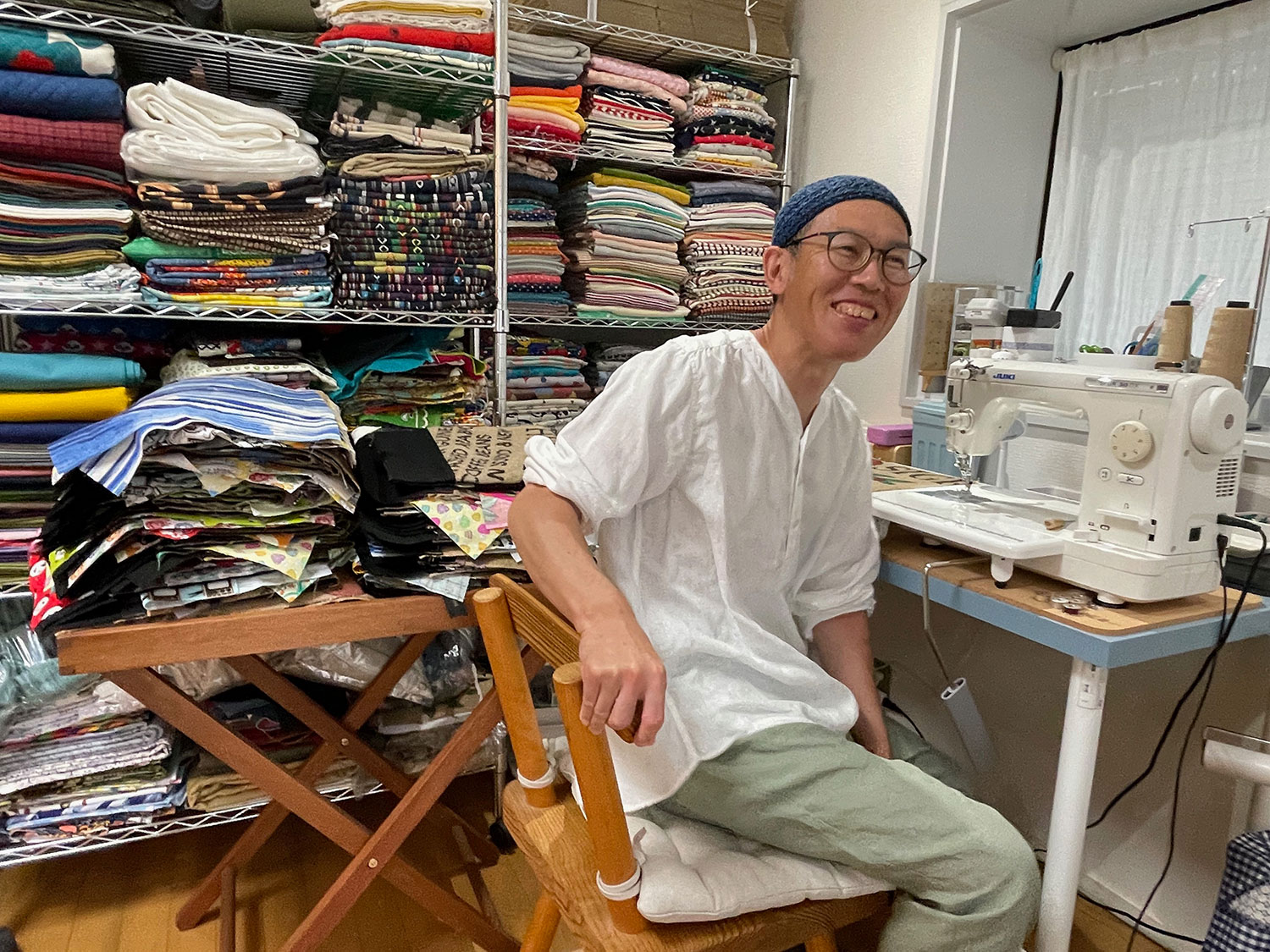
Isamu handles the "totonoe" finishing process. Photo: Staff O
"But it wasn't work he'd originally chosen because he wanted to do it, and he didn't have something else he really wanted to do either. So he told me he actually envied people who were leaving their companies — because they'd found what they wanted to do," says Isamu.
Exhibiting at PLUG IN had made it possible to secure sales opportunities throughout the year.
"Could I really keep pushing harder on my own? I'd hit my limit — inventory volume, all of it. I just didn't have enough hands."
That's how Yuki describes it.
Isamu, who had watched Yuki all along, had noticed the same thing. He says the feeling that there might be something he could contribute too gradually took root in him.
"As a housewife, people see it as, 'well, you can do what you like because your husband is working,' and the effort I was putting in gets brushed aside. So I told Isamu, 'Go pay for lessons yourself and learn.' So he started attending a lifelong-learning course at Bunka. After that, he came to me and said he wanted to help out as part of HOLOHOLO BIYORI. But I arrogantly thought, he can't possibly work as my equal. I didn't have the time to train someone with no experience either. So at first I only asked him to do simple things like price tagging — but while I was running a pop-up alone, it turned out he'd been practicing on the sewing machine. Finding out he'd been quietly putting in the effort really moved me."
In the early days of working as a two-person team, since they were also a married couple sharing a life together, there were times work didn't stay entirely businesslike. Each time, they talked it through, resolved it, and gradually built their own working style. Now, Isamu handles the entire "totonoe" finishing process on his own.
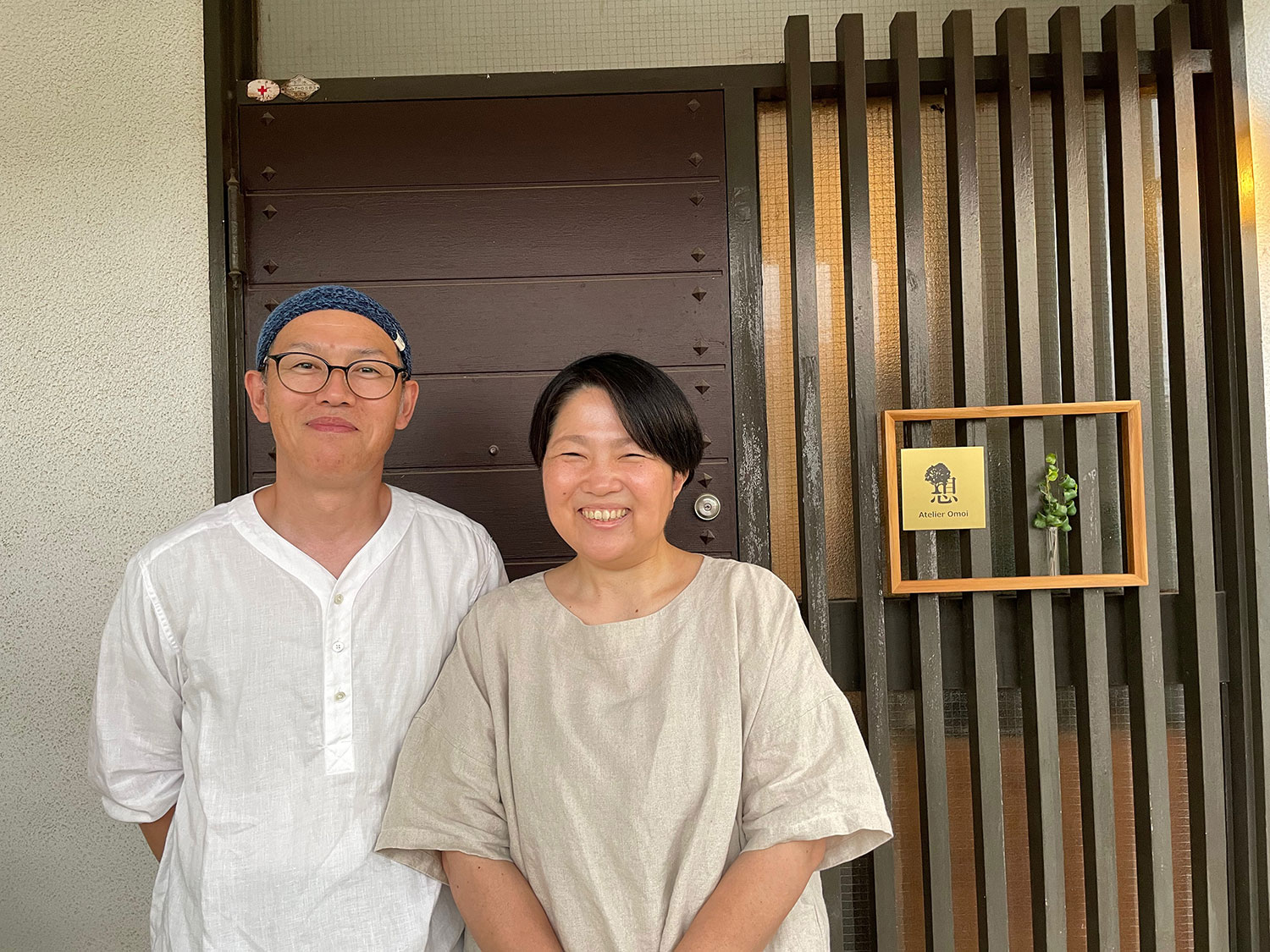
At the atelier. Photo: Staff O
They've turned an old house in Atsugi, which they moved into last December, into a combined atelier and home. The surroundings are peaceful, and Mt. Oyama's lush green form is visible from the window. Having a garden where they could dry burlap sacks was an absolute requirement.
Finally, we asked about their goals going forward.
"Honestly, I'm still figuring it out. There's a tendency for people to jump to conclusions before we've even explained anything — 'Oh, an SDGs brand.' I keep thinking about whether there's a place or a way to express our creative work more fully. Alongside what we're doing now, I'd also like to make products under Atelier Omoi, carrying our own name. I want to keep spreading materials that are simple, yet carry a story."
Their most recent pop-up recorded the best sales in HOLOHOLO BIYORI's history. It came from three people, including support staff, standing at the sales floor together — and alongside the sense of accomplishment, it also left her with a sense of alarm about stepping into the world of "volume."
"I think being a creator is work where you can carry something different from mass-produced goods. You do need to make at least a minimum living, but it's work where you can carry a kind of 'humanness' along with it — call it a certain rawness of feeling, maybe. That's exactly why, as my own style, I want to work with people I can genuinely connect with — and the next time we exhibit at a trade show, I want the two of us to have made what we want to communicate even clearer before we go."
From exhibiting at the trade show two years ago, when she says she was simply desperate to make business connections, HOLOHOLO BIYORI is now clearly moving toward its next step.
When we visited the atelier for this interview, they served us iced coffee, lightly roasted by the very roastery that supplies their burlap sacks. It had no rough edges at all — clean and refreshing.
It felt just like the two of them, facing their craft.
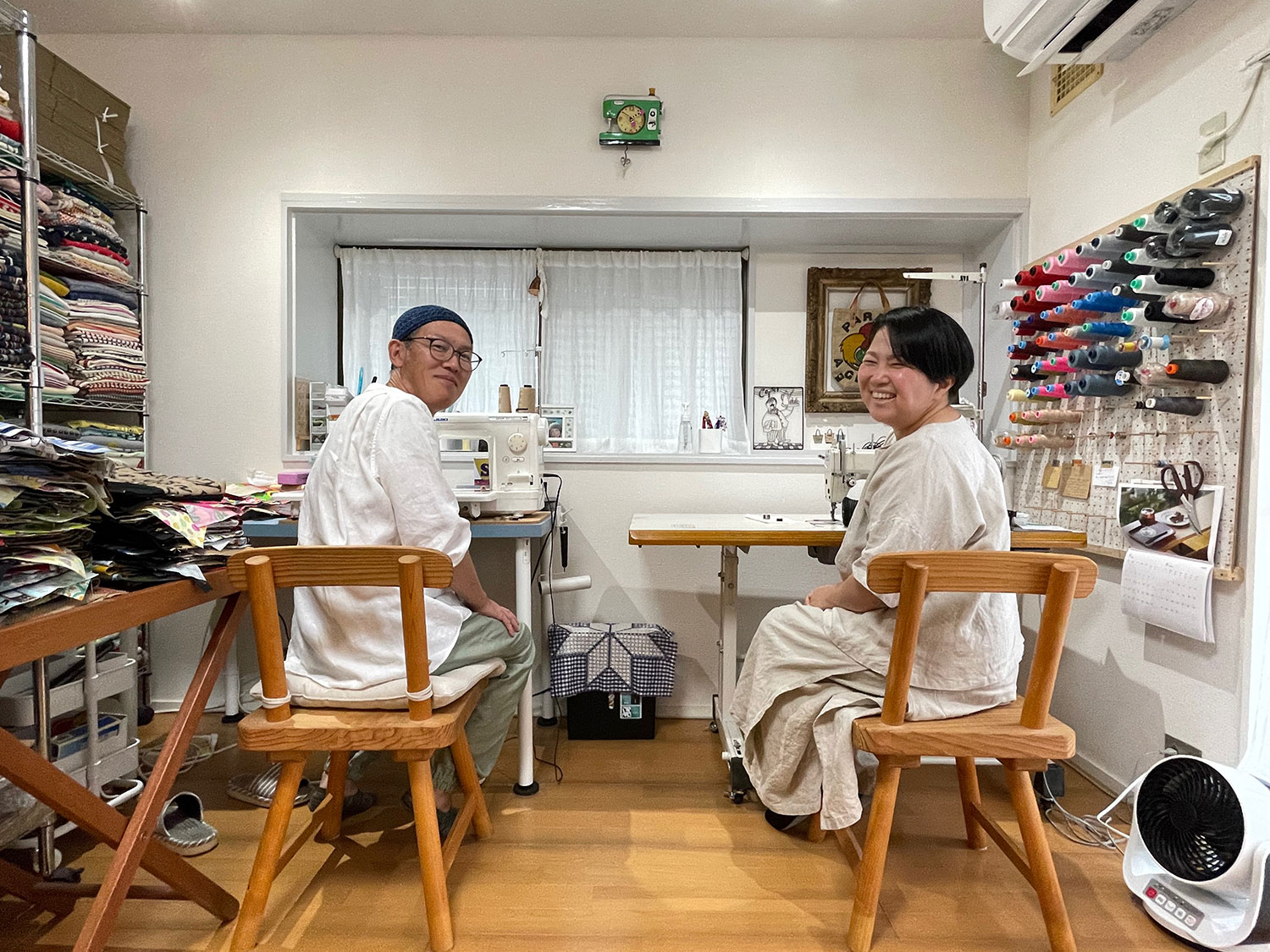
The two say they're establishing their own way of working as partners. Photo: Staff O