

Building a Brand Using the Techniques of TV Show Production
ADELLY Director Miki Komatsu
UPLOADED 08 DECEMBER, 2020
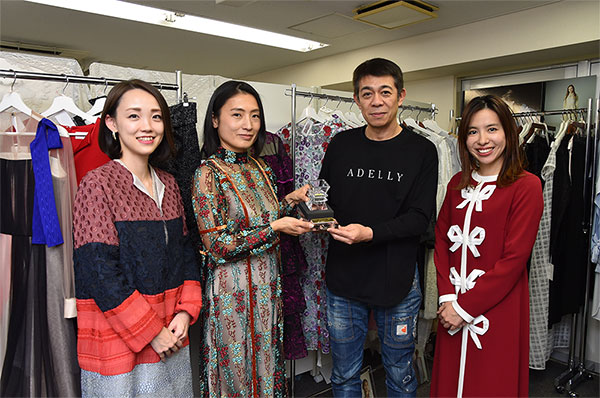
At the "PLUG IN GRAND PRIX," in which visitors to the joint trade show "PLUG IN" (hosted by Senken Shimbun) vote for their favorite brand among the exhibitors, ladies' apparel brand "ADELLY" was voted first place three times running — at the October 2018, March 2019, and October 2019 shows — earning it a place in the Hall of Fame. Behind that strong showing lies a distinctive approach to branding and way of working. We spoke with director Miki Komatsu.
Congratulations on the three-peat — that's a first.
Komatsu: "I'm honestly surprised that a brand started by people with no background in clothing has been chosen for the Grand Prix three times. The comments people wrote on the ballots have really energized us. The response has been huge — we've had inquiries from retailers wanting to carry us and offers to open limited-time shops, along with more proposals from material makers too. It's made me realize this is how a brand grows, one step at a time."
It seems like the brand's popularity comes from having a really solid sense of branding — would you agree?
Komatsu: "We started with the 2018 Spring/Summer collection. We didn't have today's brand image from day one — the company actually began as a TV production and event planning/management company. I myself worked as a stylist on production sets, but I had never studied clothing or clothing-making — a complete amateur. I didn't know sourcing partners or sewing factories either; I think we made it work through our network of outside staff. Honestly, there was no branding or business plan at the start — we launched purely on a feeling."
What kind of "feeling" was that?
Komatsu: "It started with the appeal of fashion that our representative, Akutagawa, felt while arranging costumes for talent and comedians appearing on our shows. After a stint as manager for a well-known comedy talent, he started the company, and through his work in TV production he came to feel that while the laughter and atmosphere people create together on a show end in an instant, fashion can excite many people at once and lift each person's mood — and beyond that, every time you wear a piece you love, that same excitement and joy comes back. Realizing fashion's appeal that way, he wanted to bring that feeling to life. So there was no concept or image at the start — we launched purely on that feeling."
So I hear the concept itself came together in a short time.
Komatsu: "It took about six months from pulling the concept together to finding fabric and a factory and launching. I think it moved fast because, even though it was my first time making clothes, my opinions were taken on board. A lot of what I'd felt through my stylist work became possible to realize.
I think that was possible because it was built on the way of working we'd developed in our core business, TV production. In making a show, a producer develops the concept, a director decides the story and script, the cast performs, and the crew's work brings it all together into one program. We unconsciously adopted that same approach at ADELLY. President Akutagawa, who knows what I like and dislike, plays the producer, deciding the brand's overall direction and managing the finances; I, as director, work out the concrete themes and content, then coordinate with outside production-management staff, pattern makers, sewing factories, and other production staff to finish the product. Because the team was small, communication was easy and everyone's role was clear. I think that's what kept our collections cohesive."
ADELLY has a lot of distinctive products, and the brand really leaves an impression.
Komatsu: "There are a few things we're particular about in our planning and proposals. Making the one-piece dress our signature item is one of them. A one-piece makes a strong impression on a woman, and since a single piece completes a look, it's easy to style and combine, so it doesn't stress the wearer out. On top of that, it's the perfect item for our brand concept — "clothes that lift a woman's mood and give her days a little excitement," "clothes that stay in the memory" — so among the 25 to 30 styles we propose each season, we always include at least four one-piece styles. Having a clear core item also strengthens the brand's impression. We're also particular about sheer fabrics and embroidery, because they let us express the keyword "emotional." That said, we deliberately don't keep any style as a continuing item. It would limit who can wear it, and if we don't keep bringing in expression that reflects the times, it starts to look dated — so every season we adopt new materials and new embroidery techniques for new products. We've never really struggled with choosing fabric or embroidery. But I also don't think embroidery and fabric alone are what make a brand stand out. I think keeping the product and item mix, planning, proposals, and positioning close to the standard, while putting real effort into weaving in expression that reflects the era, is what leads to a result that doesn't feel off."
What do you mean by "orthodox clothes leaning toward special occasions"?
Komatsu: "That's a style I personally like. Adding accessories turns it into a 'beautiful office style' that also works for a dinner or party, and our goal is clothing that makes women in our target age range — late 20s to 30s — stand a little straighter when they wear it, clothing that changes how you carry yourself and even how you speak.
What do you prioritize when setting prices?
Komatsu: "Our one-piece dresses run from around ¥30,000 to the ¥60,000s. We set prices that feel justified — high enough that the wearer can feel proud, while still being something you can buy without overreaching, and versatile enough in styling to work for special occasions too."
You also put a lot of effort into how you communicate the brand.
Komatsu: "We lend a lot of pieces to female news anchors and actresses, and we're deliberate about communication aimed at how the clothes look on TV — an area where my stylist career comes in handy. I don't think it's right to lean so heavily on communication that you neglect the strength of the product itself, but I also don't think relying purely on media exposure is the right approach either. For ADELLY, the product always comes first — we put the thought behind our making and planning first and foremost. Narrowing down promotion comes next in order: once the whole collection is finished, we picture which actresses or anchors we'd like to see wear each piece, then choose the magazines that fit. That's because pursuing sales by relying on talent and celebrity connections from our core TV production business isn't the direction we're aiming for."
What kind of direction are you thinking about going forward?
Komatsu: "We want to keep expanding the brand's world. That said, we're not simply aiming to grow the business bigger. It's because we want to add items like shoes and bags to keep satisfying women's moods and emotions. As a step in that direction, and to give shape to the world we're aiming for, we've begun trial initiatives such as introducing notable local shops in the brand's own original catalog, with an eye toward future collaborations. We'd also like to plan events, offering spaces and moments where people can enjoy the comfort of dressing up, and our dream is to build face-to-face communication that goes beyond being just a clothing brand."
(This is an edited and re-recorded version of an interview conducted on December 24, 2019.)